Russian Imperial Guard
War and PeaceThe Russian Imperial Guard represents the privileged, highly visible face of the Russian military establishment. It is associated with court proximity, immaculate uniforms, social distinction, and advancement through personal connections, but its prestige does not place it outside the hardships and uncertainties of campaigning. Through the careers of Boris Drubetskoy and Nikolai Rostov, and through the contrast between ceremonial spectacle and soldiers’ suffering, the Guard becomes both a social institution and a measure of the novel’s skepticism toward military glamour.
Nature and Imperial Prestige
The Guard is distinguished from ordinary line formations by its closeness to the imperial court and by the opportunities it offers ambitious officers. Boris Drubetskoy, recently commissioned as a cornet, regards transfer into the Guard as a decisive improvement in his prospects. After Anna Mikhaylovna Drubetskaya appeals to Prince Vasili Kuragin, the matter is brought before the Emperor, an exception is made, and Boris is transferred into the regiment of Semenov Guards. The appointment confirms that Guard service is not governed solely by battlefield merit: court influence and personal intervention can alter an officer’s career.
The transfer also exposes a limitation within the institution’s privilege. Despite Anna Mikhaylovna’s further efforts and entreaties, Boris does not obtain a place on Mikhail Kutuzov’s staff. The Guard can open a door without guaranteeing entry into the highest circle of military power. Its members possess distinction, but they must still negotiate the hierarchy of patronage, headquarters appointments, and imperial favor.
Display, Discipline, and Collective Identity
The Guard participates in the military culture of display that surrounds the imperial armies. At the review of the Austrian and Russian forces, thousands of soldiers move in ordered formations beneath flying banners, while cavalry, artillery, bands, generals, and decorated officers create an image of overwhelming precision. Every soldier appears freshly washed and shaved; weapons are polished, horses groomed, and cannon shine. Such ceremony gives the army a visible identity as an enormous, disciplined whole, in which each individual is insignificant alone but powerful as part of the collective.
The review produces an emotional conviction that imperial command guarantees victory. Nikolai Rostov and many other officers believe that an army commanded by the Emperor cannot fail to defeat any opponent, and the confidence generated by the spectacle seems greater than that produced by actual victories. The Guard therefore embodies the persuasive force of military pageantry: uniforms, banners, ranks, and imperial presence transform organization into a felt promise of invincibility.
Yet the same military system reveals its material weaknesses when inspected outside the ceremonial field. At Braunau, a regiment that has marched twenty miles is kept awake all night cleaning and repairing itself for inspection. Its appearance becomes immaculate, but more than half the men’s boots are full of holes after a march of roughly seven hundred miles, because the Austrian commissariat has failed to provide replacements. The contrast clarifies the limits of parade discipline. The Guard’s polished public image belongs to an army whose basic equipment and supply arrangements can remain gravely defective.
Officers, Advancement, and Social Mobility
For Boris, the Guard is a means of constructing a future. He contrasts his own dependence on intelligence and opportunity with Nikolai Rostov’s financial security, reasoning that he cannot afford to reject patronage or appear unwilling to serve powerful people. His visit to Olmutz, where headquarters, diplomats, the two Emperors, and their courts are gathered, intensifies his desire to enter that elevated world. The streets display an order above his present rank, filled with carriages, plumes, ribbons, and medals; even in a smart Guardsman’s uniform, he feels nearly invisible among the exalted figures around him.
Boris’s ambition is consequently social as well as military. He seeks an appointment as adjutant to an important personage, a post that promises proximity to authority and further advancement. The Guard provides the uniform and status that make such aspirations plausible, but the institution also makes hierarchy conspicuous. Its officers are taught to read military service as a network of access: who can recommend them, which headquarters will receive them, and how close they can come to the imperial center.
The contrast with Nikolai Rostov is equally important. Rostov’s identity is rooted more directly in regimental life and in loyalty to comrades, while Boris approaches the Guard as a professional ladder. Their differing attitudes show that the same institution can signify honor, belonging, or calculated advancement, depending on the officer who wears its uniform.
Campaigning and the Material War
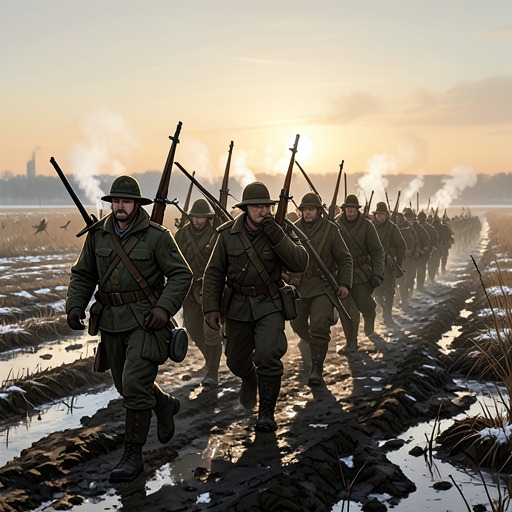
Guard privilege does not abolish the physical conditions of war. The Russian army’s retreat along the Danube is shaped by a hundred-thousand-man French force under Napoleon Bonaparte, hostile local populations, unreliable allies, inadequate supplies, and unfamiliar strategic conditions. Russian forces under Mikhail Kutuzov conduct rearguard actions at Lambach, Amstetten, and Melk only far enough to preserve their heavy equipment and continue withdrawing. The wider military environment in which the Guard operates is therefore governed less by heroic freedom than by roads, provisions, exhaustion, transport, and the preservation of an already weakened army.
The same pressures become still more severe in the Pavlograd Hussar Regiment. Near a ruined German village, a thaw turns roads to mud and makes transport impossible; provisions for the men and fodder for the horses fail to arrive. Soldiers scatter through abandoned villages searching for potatoes, while inhabitants have nothing left to give and soldiers sometimes hand over their last rations instead of taking from them. Although the regiment loses only two men in action, it loses nearly half its strength to hunger and sickness. This disparity between combat losses and logistical losses makes the novel’s military world unmistakable: an army may remain nominally intact while its bodies are being destroyed by supply failure.
The Guard is likewise caught in the larger historical movement that carries the Russian army from the campaigns of 1805 and 1807 toward the catastrophe of the French invasion of Russia. At Tilsit, the military world briefly becomes a diplomatic spectacle. On June 27, the preliminaries of peace are signed; Emperor Alexander I and Napoleon exchange decorations, and Russian and French Guards are to dine together, with the Preobrazhensky Regiment representing the Russian side. The scene turns former enemies into ceremonial companions without erasing the instability beneath the performance. Military institutions can be made to enact friendship by imperial command, but the ceremony remains dependent on political circumstances that can change again.
Historical Significance
The Russian Imperial Guard’s importance lies in its double function. It is an elite body that concentrates imperial prestige, and it is also part of an army exposed to fatigue, hunger, defective equipment, retreat, and mass death. Its parade formations make military power appear deliberate and personal, while the campaigns show how events depend on countless conditions beyond the intentions of emperors and generals.
This tension links the Guard to the novel’s broader criticism of heroic explanations of history. The review encourages officers to believe that imperial command alone assures victory, but the retreats and supply disasters reveal how little ceremony can control. The later destruction of the French invasion force, the Russian suffering during the campaigns, and the deaths that follow war all place the Guard’s brilliant surface within a much larger process. Its uniforms and courtly privileges remain real, yet they cannot exempt its members from the impersonal pressures of armies, populations, weather, roads, hunger, and historical necessity.